
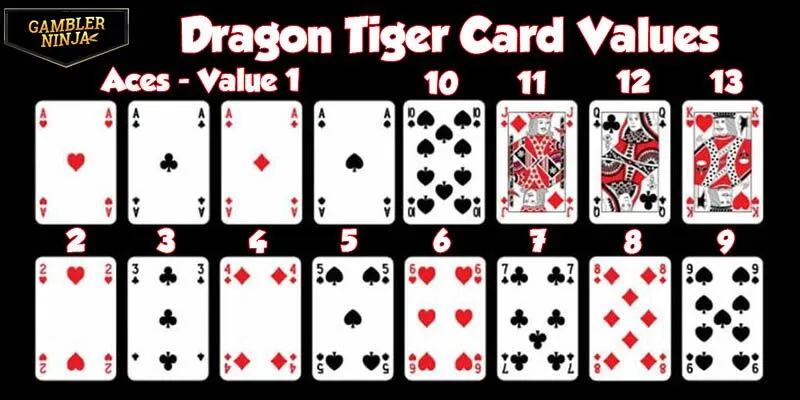
If you are looking for the absolute fastest, most straightforward card game in the casino, Dragon Tiger is the clear winner. Often described as a two-card version of baccarat, this fast-paced game strips away complex drawing rules, calculation steps, and multi-card hands.
In Dragon Tiger, only two cards are dealt per round—one to the Dragon sector and one to the Tiger sector. The higher card wins. Because the entire game hinges on a single comparison, mastering the card values and rankings is all you need to play like a seasoned pro.
What Are Card Values in Dragon Tiger?
Why Card Values Matter
Unlike blackjack, where you add card values together to reach 21, or baccarat, where you drop the tens digit, Dragon Tiger requires zero addition. The value of a card is simply its individual rank. Since the dealer compares just two cards, knowing which card beats which is the entire game.
How Dragon Tiger Differs From Other Card Games
In poker or blackjack, an Ace can be high or low depending on the situation. In Dragon Tiger, card values are completely static. Every card has a fixed rank, and there are never any third cards dealt to change the outcome.
Dragon Tiger Card Value Chart
Dragon Tiger uses a standard 52-card deck. The cards are ranked strictly by their numerical and face value, with Aces always representing the lowest possible rank and Kings representing the highest.
Lowest                                                                   Highest
  A  ──>  2  ──>  3  ──>  4  ──>  5  ──>  6  ──>  7  ──>  8  ──>  9  ──>  10  ──>  J  ──>  Q  ──>  K
 (1)     (2)     (3)     (4)     (5)     (6)     (7)     (8)     (9)     (10)    (11)    (12)    (13)
Ace: The Lowest Card
- Numerical Value: 1
- The Ace is the weakest card on the board. It loses to every other card in the deck.
Number Cards (2 to 10)
- Numerical Value: Face Value (2 through 10)
- These cards retain their exact numerical value. A 7 beats a 5; a 10 beats a 9.
Jack, Queen, and King
- Jack (J): Value of 11
- Queen (Q): Value of 12
- King (K): Value of 13 (The absolute highest card in the game; beats everything else).
How Card Values Determine the Winner
Comparing the Dragon and Tiger Cards
The dealer places one card face-up on the Dragon box and one card face-up on the Tiger box.
- If the Dragon card is higher, players who bet on Dragon win even money (1:1).
- If the Tiger card is higher, players who bet on Tiger win even money (1:1).
What Happens When Both Cards Have the Same Value?
If both the Dragon and Tiger sectors receive cards of the exact same rank (for example, a Jack of Clubs on Dragon and a Jack of Hearts on Tiger), the hand is declared a Tie.
Tie Rules Explained
If a Tie occurs:
- Players who bet on the Tie box are paid out at 8:1 (or 11:1 in some specific casino variants).
- Players who bet on Dragon or Tiger do not lose their entire stake. Instead, the casino takes a 50% commission fee, and returns the remaining half of your bet to you.
Dragon Tiger Card Ranking Examples
-
Example 1 (Dragon Win):
- Dragon receives a King ().
- Tiger receives a Queen ().
- Result: Dragon wins ( beats ).
-
Example 2 (Tiger Win):
- Dragon receives a 3.
- Tiger receives an Ace ().
- Result: Tiger wins ( beats the lowest value, ).
-
Example 3 (Tie):
- Dragon receives an 8 of Spades.
- Tiger receives an 8 of Diamonds.
- Result: Tie. Tie bets win; main bets lose 50% of their value.
Card Values vs. Card Suits
Do Suits Affect the Outcome?
In standard Dragon Tiger, suits do not matter. A 9 of Spades holds the exact same mathematical value as a 9 of Hearts. If they go head-to-head, it results in a standard Tie.
Variations Where Suits May Matter
Some online live-dealer suites offer a side wager called the Suited Tie. For this bet to win, the Dragon and Tiger cards must match in both rank and suit (e.g., both are the 7 of Clubs). Because this requires multiple decks in the shoe, it is highly rare and typically pays out at 50:1.
Common Dragon Tiger Betting Options
Note on Big/Small Side Bets: A score of exactly 7 results in an automatic loss for both Big and Small bets, which is how the house secures its edge on these side wagers.
Common Mistakes About Dragon Tiger Card Values
Confusing Dragon Tiger With Baccarat
In baccarat, tens and face cards are worth 0, and 9 is the best hand. In Dragon Tiger, Kings are worth 13 and are the best cards, while 9 is a mediocre middle-tier card.
Assuming Ace Is the Highest Card
Many players transitioning from poker or blackjack instinctively assume the Ace is high. In Dragon Tiger, the Ace is strictly the lowest card (value of 1).
Misunderstanding Tie Rules
New players are often shocked when they lose half their bet on a tie. Always remember that a tie result retains 50% of your main Dragon/Tiger bet as a house commission.
Tips for Remembering Dragon Tiger Card Values
- Think of Card Values as Numbers 1 to 13: If you struggle to remember face card values, physically translate them in your head: , , , .
- Practice in Free-Play Mode: Play a few rounds of free demo modes online. Because the pacing is rapid, playing 20 hands without real money is the fastest way to build muscle memory.
- Avoid the Tie Bet Trap: While the 8:1 payout looks highly lucrative, it carries a massive 32.77% house edge. Stick to Dragon or Tiger for a much more sustainable session.
